Gosford 3D-printed gun case: Shane Bridekirk wins bail as 14 alleged firearms charges, seized weapons and digital evidence face court scrutiny.
Why did a Gosford man accused of making 3D-printed guns get bail? Inside Shane Bridekirk’s 14 alleged firearms charges and the evidence before court.
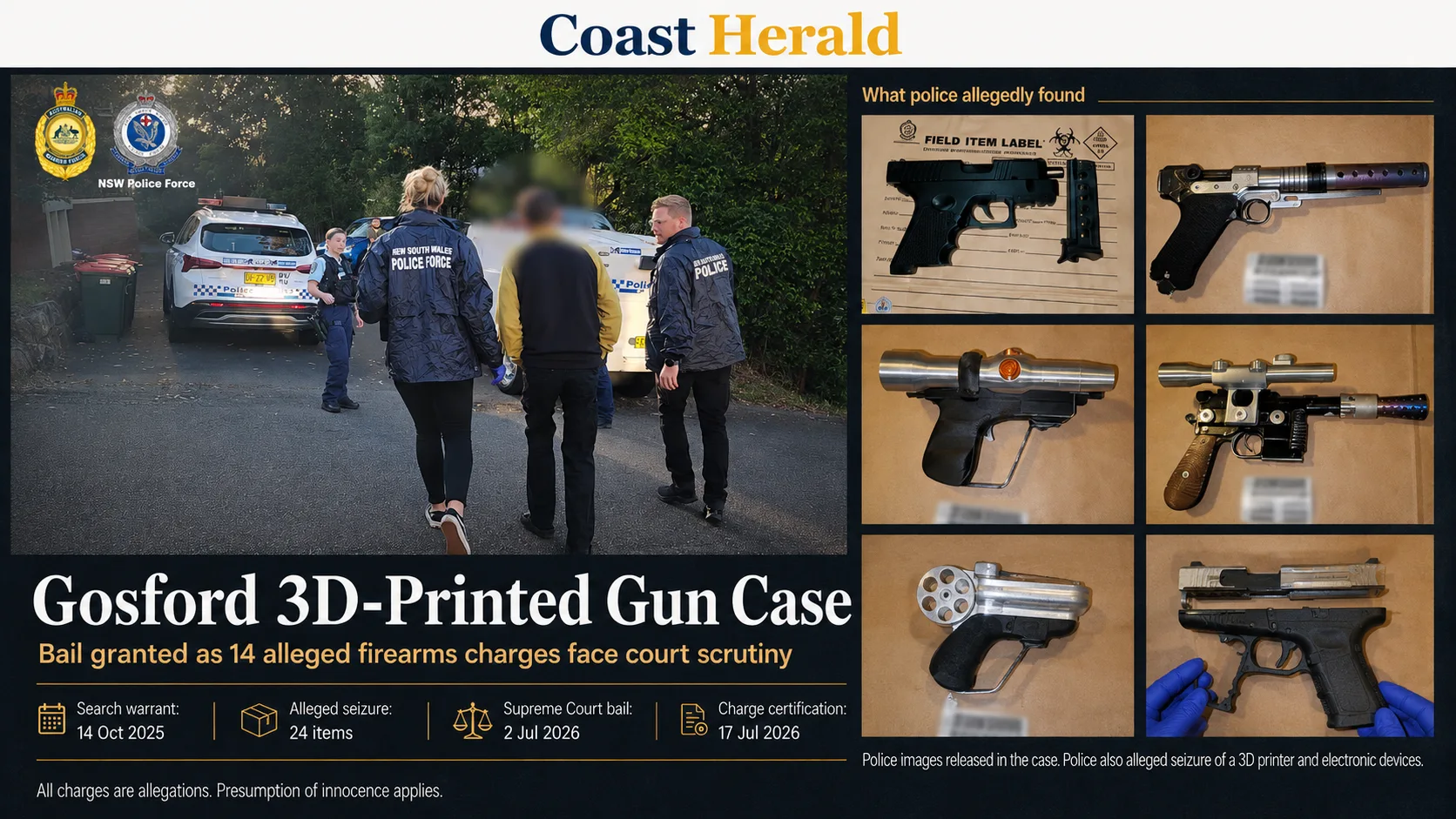
A Gosford man accused of manufacturing prohibited firearms with a 3D printer has been granted bail after the NSW Supreme Court heard the alleged weapons were made out of curiosity rather than for sale or criminal use.
Shane Matthew Bridekirk, 53, appeared before Acting Justice Monica Schmidt in Sydney on 2 July. He faces multiple firearms charges arising from an October 2025 police search of a Gosford property.
No pleas have been entered, the charges remain before the courts and none of the allegations has been proven.
The matter is expected to return to court on 17 July for charge certification — a formal review of which charges are supported by the available evidence.
What police allegedly found in Gosford
Police executed a search warrant at a Gosford address at about 6.15am on 14 October 2025.
According to the original police account, officers seized 24 items, including:
- a 3D printer
- three allegedly manufactured Glock-style pistols
- firearm magazines
- 3D-printed holsters
- an imitation revolver;
- electronic devices considered relevant to the investigation
Bridekirk was arrested at the property and taken to Gosford Police Station.
Police said he was charged with 14 offences, including allegations of possessing unauthorised prohibited firearms, possessing unauthorised pistols, possessing unregistered firearms, manufacturing firearms without a licence or permit, and failing to keep firearms safely.
The Gosford search was part of a wider national operation targeting illegal and privately manufactured firearms.
The National Illicit Firearms Working Group, formerly known as Operation Athena, coordinated enforcement activity across Australia and New Zealand between 13 and 19 October 2025.
Authorities reported 184 arrests, 854 charges and the seizure of more than 1,000 firearms and firearm parts during the week. The total included 281 privately manufactured or 3D-printed firearms and parts.
Why the Supreme Court granted bail
During the bail hearing, Bridekirk’s lawyer, Jane Murray, told the court her client had strong community ties, no criminal history, no known criminal associations and stable full-time employment available if released.
The defence argued the alleged manufacturing was connected to Bridekirk’s personal interest in technology and firearms, rather than any plan to sell, distribute or use the weapons for a violent purpose.
Strict proposed bail conditions were also said to limit his access to computers and 3D printers.
The Crown opposed bail, pointing to the number and nature of the alleged weapons. Prosecutors argued that privately manufactured firearms are unregulated, difficult to trace and capable of entering the wider community.
Acting Justice Schmidt reportedly described the alleged conduct as an “act of sheer stupidity” driven by curiosity about whether firearms could be produced using a 3D printer.
The judge granted bail after taking into account Bridekirk’s lack of criminal history, the absence of any alleged criminal connections and the proposed restrictions on his activities.
Coast Herald court review: bail is not an acquittal
The bail decision does not mean the court found Bridekirk innocent.
A bail hearing is concerned with whether an accused person can be released safely while a case continues. The court considers matters such as the seriousness of the allegations, the strength of the prosecution case, criminal history, community ties, the risk of further offending and whether bail conditions can reduce those risks.
Under the NSW Bail Act 2013, bail must be refused where the court finds an unacceptable risk that cannot be adequately addressed by conditions.
The Supreme Court’s decision therefore concerns Bridekirk’s position before trial. It is not a final ruling on whether the alleged firearms were legally classified as prohibited weapons, whether they were operational, or whether the prosecution can prove the manufacturing charges.
At the time of publication, Coast Herald had not located a published written judgment for the bail decision on the NSW Caselaw database. The available details of the hearing come from court reporting.
What charge certification means
Charge certification is one of the most important stages before a serious NSW criminal case moves towards trial or sentence.
The NSW Office of the Director of Public Prosecutions will examine the police brief of evidence and decide which charges are properly supported.
The ODPP may:
- continue with the original police charges
- add further charges
- file alternative charges; or
- withdraw charges that are not supported by sufficient evidence
Once the charge certificate has been filed, the prosecution and defence generally take part in a case conference. The matter may then proceed towards an agreed plea or be committed for trial.
The 17 July listing is therefore not a trial or sentencing hearing. It is the point at which the formal prosecution case should become clearer.
The evidence likely to decide the case
The public police statement establishes what officers say they seized. It does not reveal the complete forensic case.
Several questions are likely to be important as proceedings continue.
Were the alleged pistols capable of firing?
Forensic testing may determine whether the three alleged Glock-style pistols were operational, capable of being made operational, or incomplete objects requiring substantial additional work.
The answer may affect how the items are classified and how seriously the alleged conduct is viewed.
Which parts were printed and which were commercially made?
Many privately manufactured firearms combine printed components with metal barrels, springs, slides, firing pins or other regulated parts.
The prosecution brief may need to establish which components were produced at the Gosford property, which were purchased elsewhere and how they were allegedly assembled.
What was found on the electronic devices?
The seized electronics may contain design files, printing records, internet searches, purchase records or communications.
Digital evidence could help establish whether the activity was limited to private experimentation or connected to a wider plan to manufacture or supply firearms.
The original police statement did not publicly announce a charge of possessing digital blueprints for the manufacture of firearms. That position could change during charge certification if prosecutors consider the evidence supports an additional or alternative charge.
Is there any evidence of supply?
The current public reporting does not identify an alleged customer, sale, delivery, criminal organisation or plan to move the weapons into the community.
That absence is significant at the bail stage, where the court heard there was no suggestion Bridekirk had criminal connections.
It does not prevent the prosecution from pursuing manufacturing and possession charges. In NSW, allegedly making a firearm without legal authority can itself constitute an offence, even where no completed sale or violent use is alleged.
Curiosity does not make the conduct legal
The defence explanation that the alleged firearms were made out of curiosity may be relevant to bail and, in the event of a conviction, to an assessment of seriousness and sentence.
It is not automatically a defence to an allegation of unauthorised firearm manufacturing.
The central issue is not simply why an item was made. The court must ultimately consider what was made, whether it was legally a firearm or prohibited firearm, whether Bridekirk knowingly possessed or manufactured it, and whether he had the necessary licence, permit or other authority.
That distinction is important for residents following the case.
The Supreme Court did not approve private firearm manufacturing. It decided that, under strict conditions, Bridekirk could remain in the community while the prosecution process continued.
Similar cases on the Central Coast and in surrounding regions
The Gosford investigation is not the first time 3D-printed firearms or components have appeared in police operations north of Sydney.
Woy Woy arrest during 2021 firearms investigation
In June 2021, the Australian Federal Police and NSW Police announced an investigation into the alleged manufacture and supply of prohibited firearms.
Investigators said they had seized two 3D-printed submachine guns, three other firearms and 28 sticks of explosives during the broader operation.
A 21-year-old man was arrested at a Woy Woy home and taken to Gosford Police Station. He was later released pending further inquiries.
The wider investigation involved allegations of firearm sales, stolen vehicles, explosives and organised criminal activity. It was therefore substantially different from the publicly reported allegations in the current Gosford case.
Taree man said curiosity led to firearm attempt
A comparable case was heard in Taree in 2024.
Michael Ross Tyler pleaded guilty to attempting to manufacture firearms and to two counts of possessing digital firearm blueprints.
The District Court heard Tyler was a firearms enthusiast who became curious about what a 3D printer could produce. Police had found a dismantled printed firearm, manufactured magazines, ammunition and licensed firearms at his home.
Tyler was granted bail after spending more than nine months in custody. The court heard he had no criminal record and had not intended for the attempted firearm to enter the wider community.
The Taree case shows that courts may recognise a difference between experimentation and criminal supply. It also shows that curiosity does not prevent charges or a finding of guilt.
Firearms and printed parts discovered at Barnsley
In September 2025, detectives searched a property at Barnsley, near Lake Macquarie, and allegedly discovered two rifles and numerous 3D-printed firearm parts inside a toolbox in a garage.
In January 2026, a 29-year-old man was charged with 16 offences, including 12 counts of possessing digital blueprints for firearm manufacture, two alleged manufacturing offences and two counts of possessing unauthorised firearms.
Those charges remain allegations unless and until determined by a court.
Alleged NSW–ACT manufacturing ring
A larger operation in March 2025 resulted in four men being arrested following raids in Queanbeyan, Gundaroo and Nanima.
Police alleged the group was involved in manufacturing and selling privately made firearms. Officers reported finding firearms, parts, ammunition, drugs, cash and digital blueprints.
Unlike the current public account of the Gosford case, the NSW–ACT investigation included direct allegations of firearm supply and links to organised crime.
Why police remain concerned about privately made firearms
Privately manufactured firearms are a growing concern because they may be produced without serial numbers, registration records or the normal controls applied to licensed firearm dealers.
Printed components can also be combined with imported or commercially produced metal parts.
During the October 2025 national operation, authorities warned that improved technology was making privately manufactured firearms more sophisticated. Police said the challenge now involves not only physical searches, but also digital evidence, online purchasing and specialist forensic examination.
For Central Coast residents, the Gosford case sits at the point where an individual explanation of curiosity meets the wider public risk created by firearms that may be made outside the licensed and registered system.
The court has allowed Bridekirk to remain on bail under restrictions.
The next major question is whether prosecutors retain all 14 police charges, replace some of them or add further allegations after reviewing the complete evidence.
The matter is listed to return to court on 17 July 2026.
<a href="https://coastherald.com/central-coast/court-lists/gosford-local-court/2026-07-17/">https://coastherald.com/central-coast/court-lists/gosford-local-court/2026-07-17/</a>
All charges are allegations. Shane Matthew Bridekirk is entitled to the presumption of innocence unless and until proven guilty.