Wyong 4-Year-Old’s Death on NSW Central Coast: Mother Charged with Murder, Police Investigate Cannibalism Claim, DCJ’s Last Report Was 18 Months Earlier
Wyong, NSW Central Coast: A 4-year-old boy was found dead, his mother charged with murder, as police probe cannibalism and DCJ’s 18-month gap.
Content warning: This article discusses the death of a child and allegations of serious violence.
On Saturday afternoon, a woman walked into Wyong Police Station on the NSW Central Coast.
After speaking with officers, police immediately went to a home in Wyong. Inside, a 4-year-old boy was dead.
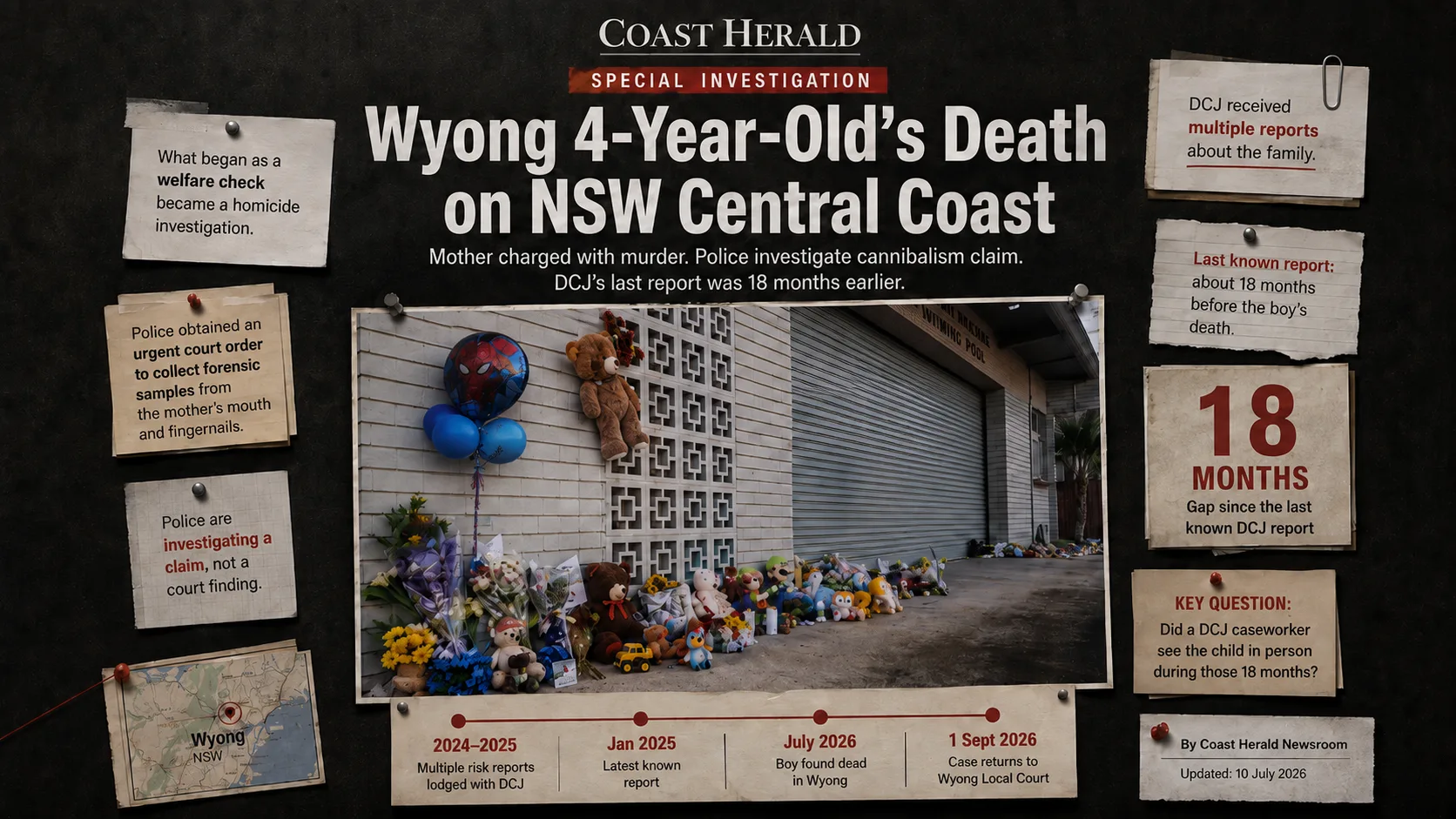
What began as a welfare check became a homicide investigation.
The boy’s mother was later charged with one domestic violence-related count of murder. She did not apply for bail and remains in custody. The case is due to return to Wyong Local Court on 1 September. Police said the mother and child lived together.
But after the boy’s body was found, the investigation took an even more disturbing turn.
Why police examined the mother’s mouth and fingernails
Police sources confirmed to the ABC that investigators are examining whether cannibalism was involved in the boy’s death.
Court documents show police obtained an urgent order before the woman was charged, allowing forensic officers to examine her.
Samples authorised under the order included material from inside her mouth, a swab from the inside of her cheek, her fingernails and material from beneath them.
The samples will undergo forensic testing. The results may become important evidence as police reconstruct what happened to the boy.
Police are investigating a claim. It is not a finding made by a court.
Whether that line of inquiry can be established will depend on the post-mortem examination, laboratory results and evidence recovered from the home.
Tuggerah Lakes Police District Commander Chad Gillies confirmed the child had injuries. He said the scene was deeply confronting even for experienced police officers and paramedics, but did not disclose the nature of those injuries.
Police are still working to establish the boy’s time and exact cause of death.
The family was already known to child protection authorities
As the police investigation continued, another question began to overtake the initial shock:
Who knew this family may have been at risk before the child died?
NSW Families and Communities Minister Kate Washington has confirmed the Department of Communities and Justice received and assessed multiple reports concerning the family.
The most recent report was made about 18 months before the boy’s death.
The Daily Telegraph reported the boy was assessed as being at risk at least three times between 2024 and 2025.
The latest report, made in January 2025, raised concerns about the boy’s safety and his mother’s circumstances.
According to the report, caseworkers believed the boy was living with another relative under court-ordered arrangements and did not carry out a face-to-face visit.
The review must now establish when the boy returned to his mother, and whether those responsible knew where he was actually living.
This case no longer carries only one question.
Police must establish what happened inside the home.
The government must explain why a child who had repeatedly appeared in child protection records was not seen face to face during the final 18 months of his life.
Independent review to examine why the boy was still living with his mother
Kate Washington has appointed former NSW Children’s Court president Peter Johnstone to lead an independent review.
The review will examine the reports received by DCJ, the decisions made by caseworkers, why the boy was living with his mother, and whether more could have been done to protect him.
The government expects the review to be completed by the end of 2026 and released publicly to the extent allowed by the criminal proceedings.
Premier Chris Minns said this week he believed the review would establish what happened during the department’s contact with the family.
Asked whether DCJ had lost track of the boy for 18 months, Minns said that, if true, it was unacceptable.
For Central Coast residents, the questions are now direct:
- After the reports were received, did anyone see the child in person?
- Before accepting that he was living with a relative, did anyone confirm it?
- When the care arrangements changed, who was supposed to know?
The warning was already in the numbers
In 2024, the NSW Audit Office examined child protection services across the state.
It found that 112,592 children were assessed as being at risk of significant harm in 2022–23.
Of those children, 75 per cent did not receive a home-based safety assessment from a caseworker.
About 85,000 cases were closed without a home visit. Around 71,000 of those were closed because no caseworker was available to take them on.
The audit also found the department spent large amounts of time repeatedly reviewing files, reducing the time available for caseworkers to enter homes and see children directly.
Those figures make the questions surrounding the Wyong case even harder to ignore.
- Reports can be recorded.
- Risks can be assessed.
- But a child’s safety cannot be confirmed without seeing the child.
Similar warnings have emerged across the Central Coast and surrounding regions
A coronial finding released in 2025 examined the death of “Jade”, a three-year-old girl who died in Muswellbrook in 2018.
The coroner found Jade died from bilateral bronchopneumonia, with neglect playing a significant role.
The inquest also examined reports previously received by child protection authorities and whether agencies and service providers acted in time.
Another coronial finding released in 2025 examined the death of a teenage girl known as Harmony.
Her case had been referred to the Central Coast Multi-Agency Response Centre, but was closed because there was no capacity to allocate a worker.
The coroner found the case had already reached the point where direct intervention and intensive follow-up were required, and that authorities had missed several opportunities to act.
- The cases were different.
- The children were different.
- The causes of death were different.
- But the question left behind was the same:
When danger is reported again and again, who actually goes to see the child?
Wyong residents leave flowers and toys for the boy
At least 40 people attended a vigil in Wyong after the boy’s death.
Residents brought flowers, candles, toys and teddy bears to a temporary memorial.
Organiser Haylee Elizabeth Dickinson said the death had devastated the local community because it happened close to residents’ own homes.
Police are urging anyone who knew the mother or the boy, or who has information about their recent circumstances, to contact Crime Stoppers on 1800 333 000.
NSW law prevents the mother and child from being publicly identified because the case involves a child connected to criminal proceedings.
The murder charge against the mother has not been determined by a court. All allegations must still be proven by the prosecution.
But before the case returns to court in September, Wyong has been left with a question that cannot be covered by flowers:
DCJ received its last report 18 months ago.
Before police entered that home, had DCJ seen this child in person at any point during those 18 months?